
While visiting Fusion’s series on the future of death, I was particularly intrigued by two articles. These articles, titled “We calculated the year dead people on Facebook would outnumber the living” and “If death becomes optional will only the rich get to live forever?”, brought to light a question regarding grief that had yet to cross my mind. In class we have discussed the multiple ways that people grieve on social media, yet we never touch the topic of those who do not have this luxury. How do poor people, or those without access to the internet, grieve? How are their options limited, and in what way?
In “We calculated the year dead people on Facebook would outnumber the living” Kristen Brown discusses her attempts to estimate when the number of dead Facebook profiles would outnumber the ones of those living. In her attempts she was turned down often, until Hachem Sadikki from the University of Massachusetts offered his services. The resulting estimate stated that around the year 2098, the social media platform would be overpopulated with dead profiles.
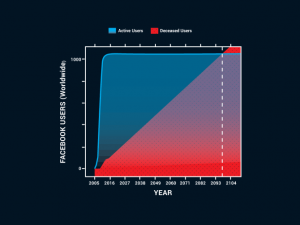
The more I thought about Facebook being overpopulated with the profiles of the dead, the more my mind strayed to to thinking about those that do not have Facebook profiles, or even simple access to the internet. How would they grieve? These questions began to develop as I read “If death becomes optional will only the rich get to live forever?” which discusses the possibilities of age and death defying technology. In this article Manu Saadia discusses the possibilities of this type of technology only being available to those who are extremely wealthy. I one hundred precent agree with this statement, as I do not believe that such groundbreaking technology would be made available for cheap. Both of these articles led to me reflecting on the exclusion of people that are not in the digital atmosphere, and therefore we do not discuss in our class.
How do people from developing countries grieve if there are no Facebook walls to posts on? How do indigenous people grieve if they have chosen to live their lives without any technological advancements? These are questions that we should also be asking. I can imagine that those who struggle to make ends meet in several countries around the world do not have much time to engage in any of the grieving actions that we have discussed in class. A farmer who heavily depends on his crop for sustenance and family support does not have the time/opportunities to grieve as we do. It is possible that they do have time to grieve, but I believe that they do not have nearly as many opportunities as those who have time to select the “Remembering” option on Facebook.
As stated before I do understand that our class focuses specifically on Death in the Digital Age, its in the class title! However, I think that discussing these questions in class give us a more worldly view of how grief is seen or performed. By comparing the grieving performances or feelings of different societies and cultures, we can achieve a deeper understanding of the norms that we see in our own social media sphere. Inequality if often discussed in terms of race and class, but no one discusses the inequality to express feelings or perform grief. It exists.