I Literally Have No Vowels

Words With Friends 2


Words With Friends 2 is basically your epitome of a casual game. No gore, no element of fear, and certainly no punishment, this game combines the classic elements and mechanics of scrabble with the ability to connect online with other individuals, hinting the “with friends” portion of Words With Friends.  The game even offers a chat box to communicate with your opponents.

Another element that makes this game fall into the casual game category is the fact that this game is about as juicy as it gets. There are bright colors, inviting sounds, and prizes to be won with the completion of weekly challenges.  All of these elements combined with extreme playability makes this game one that is accessible to almost anyone. Take a look at the trailer below to get a feel for the game and the casual atmosphere that the developers at Zynga intended with its design.

Is there anything interesting that can be said about a game like this? The academic intrigue that can be found in this game partially lies within the juxtaposition of the seemingly friendly, low risk vibe with the high stakes competitive atmosphere. You might be asking, how is this game high risk? You can’t die, there are no punishments for a loss, and, most importantly, there are no zombies trying to eat you.  Well, the punishment in this game is one that isn’t quantified within the game.  What you’re risking with this game is your pride. A win cements your superior intellect to your friends while a loss leaves you embarrassed and desperate for a rematch.

This game centers around agon competition that involves strategy, skill, and intelligence while mixing in alea factors of tile selection and opponent word placement.  This combination of agon and alea components offers another interesting component of Words with Friends: how players respond to the game. With a game that can be tied to intellect, a loss can feel like a real blow. I am interested to know if players view losses and victories differently.  What I mean is, are losses written off as unlucky results of chance while victories pinned to a players superior skill? There may be an element of this in all games that combine aspects of agon and alea, but is it more apparent in a game like Words With Friends that centers around the players intellectual ability.

A look into the tile bag

These questions will be analyzed further in upcoming blogs along with other aspects of Words With Friends. At surface level this game may not seem like much but, like any successful game, an incredible amount of thought and creativity has gone into its design and therefore this game has a lot to offer upon further inspection.

Source: I Literally Have No Vowels

Like a Bad Dream: Surrealist Horror in Rusty Lake: Roots

Rusty Lake: Roots in an escape-the-room puzzle game telling the story of the Vanderbloom family in 1860.  Dysfunctional to the extreme, this family is brimming with murder, suicide, cult-like rituals, sacrifice, and strange experiments.  What interests me the most about Rust Lake: Roots, however, is its use of surrealist horror.

I’m a lover of most things horror (the glaring exceptions being torture porn and anything with large spiders).  But spooky and scary generally delight me.  What makes Rusty Lake: Roots so unsettling is that it just doesn’t make sense.  The website TV Tropes explains that surrealist horror is “not just nightmare-inducing, it’s nightmarish in a literal way, by being surreal, disjointed, dreamlike, and filled with bizarre imagery, usually saying goodbye to all logic and sanity in the process.” 

Rusty Lake: Roots definitely fits the bill.  Some levels are more frightening than others, certainly, but the whole game feels like an incomprehensible nightmare.  There’s a recurring shadowy figure shaped like a large man with a bird’s head.  In a birthing scene, you give one baby a bottle of blood, and it drinks it happily.  Albert, one of the main characters, is frequently depicted wearing strange, frightening masks that can sometimes control the weather.  In an otherwise romantic scene, James proposes to Mary with a message written in Mary’s blood.


Mr. Crow lurking in the window. Personal screenshot.
Mary goes to sniff a flower and her face promptly begins to bleed. My screenshot.

What interests me most about this surrealist horror is its use in a puzzle game.  Puzzles are about figuring things out, finding clues and solving problems.  In Rusty Lake: Roots, solving the puzzle often only brings about more puzzling results.  Mr. Crow, as the bird-man is called, will often appear at the very end of a level.  In one level, the final step to the puzzle involves cutting out a corpse’s tongue and putting it in a jar, but you never know why.  The player solves the puzzle and figures something out only to be greeted with something incomprehensible.  I think this mismatch between the mechanics of the game and the theme is a really powerful choice.  Contrary to our usual experience, solving the puzzle often results in more questions than answers, enhancing the game’s surreal, bizzarre atmosphere.

Source: Like a Bad Dream: Surrealist Horror in Rusty Lake: Roots

FMS 321 Blog Post 1: Violence, murder, rape, political corruption – Is this real life or a videogame?

The world is chaos.  Violence and rape are rampant, politicians are corrupt, and civilians feel helpless and hopeless.  Is this real life?  No, but it is Persona 5’s game creators’ reflection of the current state of the real world. Persona 5 opens with a gameplay scene where the player, a masked teenage boy, intrudes on a grand party in a casino, and is guided through simple mechanics like “jump” and “hide” to (unsuccessfully) escape the police.  It cuts to the police interrogating the boy, but he is unable to remember why he was arrested.  There is a mysterious voice that speaks in between cuts scenes that says, “For the sake of your world’s future, as well as your own, you must remember.” This voice seems to foreshadow one of the goals of the game – save the world by discovering why you were arrested.

In the tutorial, the player is dropped into a neighborhood in Tokyo and tasked with finding his way to his new residence with Sojiro Sakura. It is a helpful level to learn the game mechanics, as well as to orient yourself in the context of the game’s story.  The left joy stick moves the player, while the right joy stick changes your point of view of the player.  Additionally, although you can only see a part of the game space in one view, a small grid-like map with icons indicating important markers makes it easy to navigate in and out of the game space.

By exploring the tutorial’s neighborhood, you can overhear other characters’ conversations.  These embedded conversations do not seem necessary (so far) to success in the game, but they do provide important information to understand the state of chaos and corruption that is the game’s world.  Some couples speak pessimistically about the economy being down and the aging population, or how “things won’t get better because of politics,” while another old man reads the newspaper and says, “Another string of rampage accidents.  I just hope none of them happen around here.”

So far, though I have played little of the game, but I am intrigued by its story and very curious how it will unfold.  Lastly, as an inexperienced gamer, I appreciate that Persona 5 gives the option of how difficult you want to make the game (safe, easy, normal, or hard), each not affecting the course of the story itself.

Source: FMS 321 Blog Post 1: Violence, murder, rape, political corruption – Is this real life or a videogame?

Let’s Make Juice

Bored at a commercial break, I take out my phone, and the next thing I know I am slicing apples, oranges, pears, and the all-important bananas. I am playing my favorite casual game, Fruit Ninja. Over the years my interest in this game has come and gone; however, with this assignment I plan to take a critical look at some of the characteristics of Fruit Ninja that make it a casual game.

According to the chapter “What is Casual?” by Jesper Juul that we read for class, Fruit Ninja meets all five of the specifications for a casual game, it is fictitious, easy to use, it has interruptibility, there is a low amount of punishment, and it is highly juicy. In this blogpost I want to specifically address the punishment and juiciness aspects of the game. Fruit Ninja has three modes, and each has a varying level of punishment. In “Zen” mode there is absolutely no punishment, fruit simply flies up for ninety seconds before the game terminates. In “Arcade” mode there is slightly more punishment; in addition to the fruit there are now bombs, which if hit will lower a player’s score by ten points and will remove any blitz that the player currently has. In the grand scheme of the game, a ten-point reduction is very small, and the blitz can easily be re-earned by slicing more combos. Even in this mode it does not appear that the punishment is overwhelmingly harsh. The final mode, “Classic,” has the strictest punishment. In this mode there is no time limit, instead the player slices fruit until he or she drops three fruit (after every 100 points one drop is erased) or until a bomb is hit. This is clearly the most severe punishment in the game, as a single errant slice could end an entire game. However, the difficulty level, especially in the early stages, makes the game very accessible to players of all abilities.

This picture shows the minus 10 points from hitting a bomb in “Arcade” mode

Finally, I want to talk about the juiciness of the game. As one might expect when violently slicing all types of fruit juice flies on to the screen. More to what Juul discusses in the aforementioned chapter, there is almost endless positive feedback, both visually and audibly. For example, when a player gets a combo a graphic pops up that tells the player about the combo, along with a special noise that only accompanies combos. In “Arcade” mode, the juiciest of all the modes, a player is capable of getting combo blitzes when he or she gets a certain amount of combos in a certain time period. A blitz is accompanied by a special light in the background of the dojo, which acts as a reinforcer for the player. In addition to the lights in the background, every blitz is accompanied by what sounds like an “ahh” from the crowd. Juiciness is one of the hallmarks of a casual game, and Fruit Ninja, at its core, is full of juice.

This picture shows the background yellow lines along with multiple examples of positive reinforcement from the previous slice

Source: Let’s Make Juice

Jumping for jewels

In my casual game post I have chosen to write about the game Bejeweled. Bejeweled is a tile match puzzle game, originally released by the company PopCap in 2001 for PCs, however since then it has undergone numerous ports to other devices and several re-releases. The version I am playing is the app titled Bejeweled Classic and contains several game modes. For this blog post however, I played only the classic game mode, of which the objective is to switch the position of two adjacent gems in efforts to create a line of 3 or 4 of the same gems. Doing this leads to that row/column of gems disappearing and being replaced by the gems above them with new gems falling in from the top. This continues until you have a score high enough to move on to another level (where the gems are shuffled) or until you can no longer create new matches. The controls for the game are fairly intuitive, requiring the player to only tap on the two adjacent gems they would like to switch, allowing the basics of the controls to be learned in under a minute. A large portion of success in this game is dependent on chance given how the original alignment of the gems, as well as the order in which they fall out of the sky is entirely random. However, despite the element of luck there is a certain nuance in recognizing patterns that can lead to combos or certain power-ups by achieving certain arrangements of gems. Bejeweled is a fairly simple game which is easy to learn and can be an excellent time-killer, as I have learned in the hour and a half I spent mindlessly matching gems. It takes a fairly simple format and adds just enough bells and whistles to keep you occupied for hours on end.

Source: Jumping for jewels

The Addictiveness of Balls and Numbers

Source

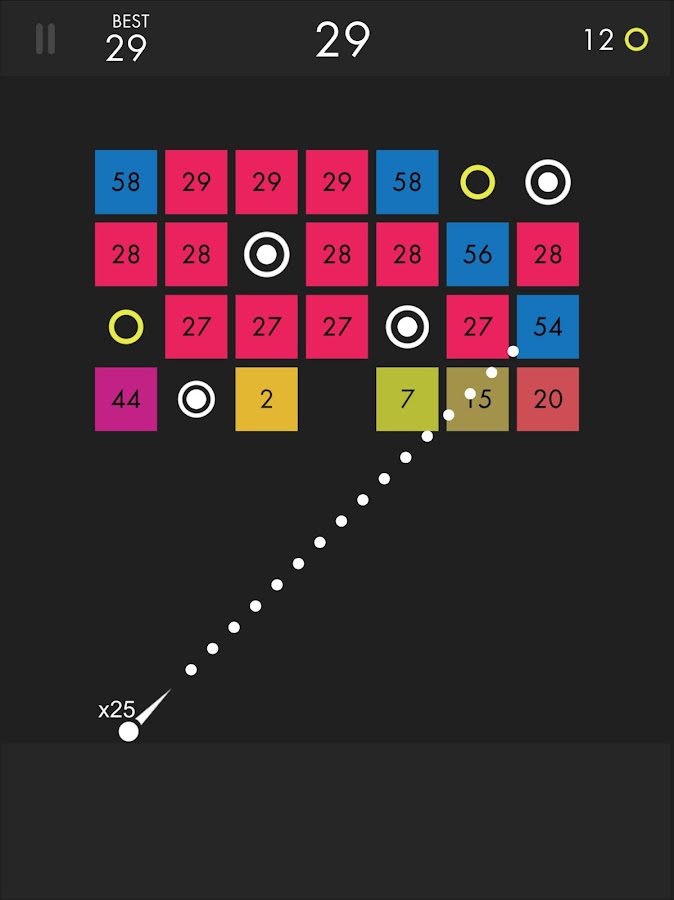
The mobile game Ballz checks off every characteristic of the “casual game.” It has a pause button which allows the player to stop and resume at any time. There is a fixed map which everything takes place on and every interaction can be easily learned in a short amount of time. In fact, there is only one thing you can do in the game. Aim.

The objective of the game is to bounce your ball off the randomly generated blocks. The blocks contain a number of at least one and gradually increases with each round. Each bounce with the ball causes the number to decrease by one and the block disappears once it hits 0. If any block reaches the bottom, the game is over. Like many casual games, Ballz is deceptively simple. I found myself getting stuck in the 30s for days at a time. While the mechanics of the game are easy to learn, they are difficult to master. It’s all in the angles. After playing several hundred rounds of the game and making it to Round 121, I realized that only way to advance is to bounce the balls off slightly horizontally so it rapidly builds momentum and destroy blocks left and right. The game is more or less built on repetition and luck (as you do not know how many blocks will enter the frame the next round, what number they will be, or what position they will be in).

In terms of “juiciness” or positive feedback loops, the game is similar to Tetris. We like having the ability to destroy and simultaneously clear spaces. There is a counter in the upper corner which shows your high score, incentivizing people to play more and beat their own record. Like many app store games, there are some microtransactions as you can buy points which enables you to change the color of your ball. That’s it. A simple reskinning. Unlike other games such as Candy Crush or Clash of the Clans, there is no buying of lives or “pay-to-win” strategies. Your money only gets you a tiny, superficial aspect of the game, an option of individualization. The strongest contrast between Ballz and other mobile games is that it has no narrative. Unless, you want to compare it to workers getting doing their work only to receive an exponentially large course load, but I wouldn’t read into it that deeply. Given its simplicity in both mechanics and aesthetic, Ballz is a definitive example of a casual game.

Source: The Addictiveness of Balls and Numbers

Game Log 1 – 3: Rocket League: Explosions & Adrenaline

For my third category of game for my game log, I chose Rocket League. The game is pretty simple. You play a variation of 2 v 2, 3 v 3, etc soccer as a car. As you might imagine, controlling a car to volley, pass, and shoot like you would as a human being in a soccer game is difficult. In fact, somewhat similar to Peggle, this game uses a difficulty curve, albeit a much sharper one, to get you hooked. I’ve played Rocket League before, but I was pretty rusty. My first few games involved lots of me missing the ball, overhitting passes, and overshooting the goal with frustrating inaccuracy. Thankfully, I gradually become more competent and began being matched with better players. After a while, the gap between my play and that of my opponents became immense again, and not in my favor.

These guys were driving on the walls, speeding around the map, and essentially exploring dimensions of the game totally outside of my capability. I felt good enough to not feel inept at the game. However, there was a clear reward for putting in more time to refine skills. In other words, this game had a relatively low barrier to entry giving the player a sense of accomplishment when achieving a sort of basic competency, but there’s also serious depth!

This game also had some serious juiciness that made the action exciting. Whenever you score a goal in Rocket League, the ball doesn’t just hit the back of the net. It creates a huge explosion that blows all that players goals in the opposite direction of the goal with seismic force, all in SLOW MOTION. It was like playing an action movie….playing soccer…as a car.

The world of Rocket League takes place in a diverse array of arenas. These levels differ in not only appearance but also gameplay-impacting level design. This provided a sort of variety to the game as I honed my skills within the same gameplay mode. This awesome combination of gameplay mechanic design and visual juiciness and variance created an addicting experience, as I intended to only play for 30 minutes and ended up playing for much much longer.

Source: Game Log 1 – 3: Rocket League: Explosions & Adrenaline

Super Casual Bros

I have been playing Super Mario Strikers for the Nintendo Gamecube and it is a good example of what a casual game plays like according to Jesper Juul. While it does fall under the category of agon and can be very competitive, it does fit into all five categories set out by Juul. To begin, the cover of the game is a picture of Mario and Donkey Kong playing a pretty fierce game of soccer. These two characters are well known throughout Nintendo and while they do look intense, knowing that it is a Mario game lets the player know that it will be a pleasant game. If you have had any experience with a GameCube controller, the controls of the game will come easily. The game has two or three important buttons for beginners but once the player gets a hang of the game can use all the buttons on the controller to perfect their playing style. Each match can be set to different settings, but the standard time limit is five minutes. The game can also be paused any time and played later so it has a high level of interuptibility. Losing the game to your opponent is the biggest punishment the game has. While playing the game, if you do something illegal, the player gets a classic Mario shell to throw around which is also a small punishment. In general, since the matches are so short, there is a very low level of punishment for the player. Lastly Super Mario Strikers has a high level of juiciness. If the player does something well within the match, like get a shot on target, the player is rewarded with a Mario shell to throw which provides very quick feedback. When a goal is scored a dramatic replay is shown and when players perform their special shot a cool cut scene is played. I would say I am a casual gamer and this game fits my style perfectly so that I can play a short game in-between class or play a couple games at night with a friend.

This shows Yoshi during a super strike. The green fire and stars show the juiciness of the game.


Source: Super Casual Bros

Cars and Guns and Bank Heists, Oh my!

Grand Theft Auto V (GTA 5) is a great example of a hardcore game. The storyline starts immediately, thrusting the player into an intense bank heist. This type of negative plot is especially appealing to hardcore gamers. You earn money by killing people, escaping the cops, robbing stores, etc. To become competitive in the online portion of the game, you have to put a lot of time into leveling up and buying gear. One unusual part of this hardcore game is the interruptibility, which is very high. You can pause the game at any point and come back to it later. There isn’t any real punishment in the game, when you die you lose a small portion of your money and respawn in the middle of the map. Sound plays a large role in GTA 5, with a large variety of music available through any vehicle’s radio. It is up to the player to choose what music they want to listen to, which appeals to a lot of people. It is evident how much time the game designers put into the games audio. Every car, motorcycle, plane, bike has its own unique and identifiable sound. The most appealing part of the game is its storyline, which gives you the chance to follow three different characters along three extremely different paths. You can play only with one main character or all three, and gives the player a lot of freedom while the game designers still have control over the deep narrative. One negative aspect of GTA is the confusing controls, and it doesn’t do a very good job of explaining them either. The button layout doesn’t follow any other stereotypical console game, making it difficult to figure out and get accustomed to them. GTA 5 would fall under the category of Agon, since it is a competitive hardcore game that is necessary for the user to be skilled at driving, shooting, and navigating the map. Not many games can claim to have better graphics than GTA 5, which provides an accurate, real world space in Los Angeles, California. Grand Theft Auto 5 is a very successful franchise because of its immersive gameplay. Hardcore gamers enjoy all of the possibilities that come with ranking up and completing challenges, while casual gamers can enjoy cruising through the streets in a number of vehicles. I would say that GTA 5 doesn’t fit my playstyle because I consider myself a more casual gamer, however my time playing was still very enjoyable because of the variety of mini games and tasks offered in game.

Source: Cars and Guns and Bank Heists, Oh my!

FREE GAME!!!

League of Legends, produced by RIOT games, is one of the most popular online computer games in the world. It has the most live streams from twitch (a video game streaming site) and has a total of 27 million users, PER DAY. This game is a revamp of an older games, those include World of Warcraft Frozen Throne and StarCraft. These games were popular games in the gaming community, however, didn’t come anywhere close to the popularity of League of Legends. But how did LOL get so big?

First, let me explain the goal of the game. The objective of this game is to destroy the enemy base. You choose a champion based off a list of 134 (not all of which you have access to immediately), all with different skills and abilities, and fight an opponent or multiple opponent. Within this game there are different ways of playing, for example there are 5v5 games, 3v3 or ARAM. All of which are played against real people from all over your region. This type of social feature increased league popularity but wasn’t the big turning point.

However, the big catch to League of Legends, and the reason Riot games became one of the leading game manufacturers, is simply due to the cost and accessibility of League. Most other games before it like StarCraft or Frozen Throne you had to go to a story to buy, it cost around 60$ to buy, and both games were rated M. However, League of Legends , you are able to download from your home, it is rated pg-13, and (drum roll please) it was also FREE. It cost nothing to download and start playing the game. This takes the Razorblade example in class to a whole other level. Riot makes no money when people download the game, however, once people are in the game, the have the option to buy things, and of course people do!

Riot’s sheer popularity by allowing the game to be free, ends up generates much more money. This strategy and tactic by RIOT games truly took the video game world by storm and transformed the way companies are marketing their products.


Work Cited:

Most Watched Games on Twitch | Esports Content and Total. https://newzoo.com/insights/rankings/top-games-twitch/. Accessed 2 Feb. 2018.

How Riot Games Created the Most Popular Game in the World | Fortune. http://fortune.com/2013/07/10/how-riot-games-created-the-most-popular-game-in-the-world/. Accessed 2 Feb. 2018.


Source: FREE GAME!!!