In the end, it was just for a slice of Cake

A game log about the video game, Portal Before taking this FMS class, I had never even heard of Portal before. The concept took a while to understand: imagine having the ability to transport through walls. That’s what defines Portal  as a new video game genre which converts 3D spaces into puzzles. Although this was my first time playing Portal, I found myself frustrated with its “appearance […]
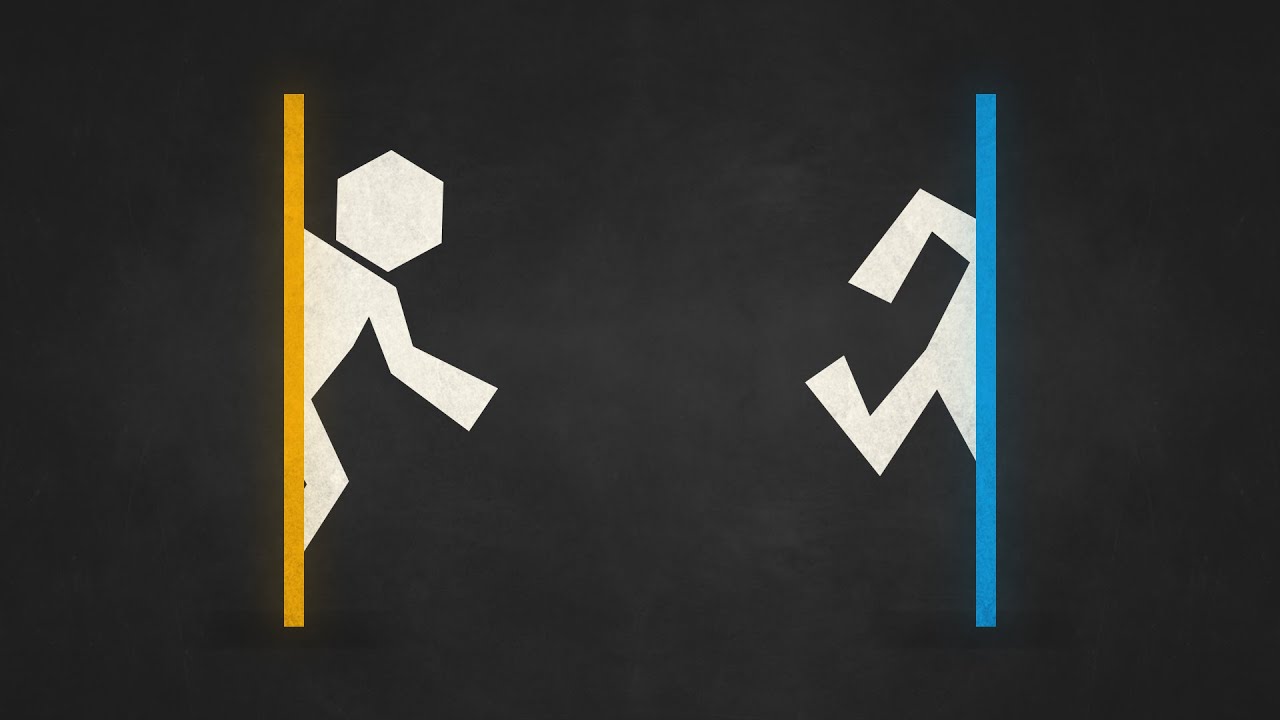
A game log about the video game, Portal

pora

Before taking this FMS class, I had never even heard of Portal before. The concept took a while to understand: imagine having the ability to transport through walls. That’s what defines Portal  as a new video game genre which converts 3D spaces into puzzles.

Although this was my first time playing Portal, I found myself frustrated with its “appearance of choice.” In this conext, I define this term as the illusion that provokes immersion and a sense of agency over Chell, the character. Yet, when the player may believe that they are discovering a new way to solve the puzzle, it’s the opposite because almost every move has already been strategically placed by the game designer. If each player were to draw out the game maps and the moves necessary to advance in the game, I wouldn’t expect them to look much different from the game designers’. The game lacks alea,  the term coined by Roger Callois for chance (Man, Play, and Game). Although this may not be seen as a bad thing, the game does not convince me to replay it. 

The story of Portal is interesting, but not as thought-provoking as I would have liked it to be. After having advanced 19 stages of puzzles and destroying the AI, Gladys, the player is awarded with cake. Solving the puzzles was a more rewarding experience than earning cake. The ending is rather sarcastic and almost confirms how Chell, did all of this for nothing nor can it be labeled as a heroine’s odyssey in Henry Jenkins’ terms (“Game Design as Narrative Architecture,” page 6). Although Portal embeds narrative elements within the mise-en-scene, it would be wrong to expect more plot development than spatial exploration from a video game like this. Because there was not much plot in the game, I found it hard to relate to my life. Maybe that’s the point; maybe Portal is  meant to only survive in its own magic circle. 


References:

Henry Jenkins, “Game Design as Narrative Architecture”

Roger Caillois, Man, Play, and Games, 1961.

Time is of the essence

The first critique I will make about the exercise is the conditioning that we received. I would have preferred that the activity be done in a way that we would have not known about the second step (rewriting) during the transcription phase. While doing the exercise, I found myself very conscious of my word selection […]

The first critique I will make about the exercise is the conditioning that we received. I would have preferred that the activity be done in a way that we would have not known about the second step (rewriting) during the transcription phase. While doing the exercise, I found myself very conscious of my word selection and sentence structure, which is not a bad nor good thing. During the speaking process,  I did not do much verbal “editing” but instead I would clarify a thought by continuing the story. Unlike speaking, writing gives us the ability to edit our thoughts by erasing and modifying until we are satisfied with what is written. We impose more filters on our written work than we do our oral presentations because editing is seen as an opportunity to refine our thoughts. As a writer, I find myself in high pressure situations whenever I have to write an essay or written piece because although editing is an opportunity, it can also be draining to know that I should take advantage of it to produce a work of high quality. The same pressure exists in an oral presentation, because the audience expects the presenter to come having already rehearsed the presentation until it has been mastered. Plato’s conversation with Phaedrus is a great complement to Walter J. Ong’s chapter in his book because it focuses more on the spontanaiety of the moment. How do we judge a presentation that is simultaneously being created at the same time? How does our judgement differ from reading a draft to reading the 5th draft from the same author? Does the ability to edit create a new meaning of text engagement?

Time is a very important concept that provides the underlying framework for oral and written work. In my AntConc results, my word count in the written piece was 20% higher than in the transcribed one. A written piece does not have a time constraint, and that allows us more time to use a wider range of vocabulary. I was not surprised to see that both I had the top 15 recurring words from both texts were almost the exact same: many pronouns and conjunctions were used. This was partly due to the fact that I was trying to rewrite the transcription word by word. The written part of the exercise was much more difficult because I did not want to be redundant nor could I remember well what I had said previously. Any repeated thought in the same written work is be considered taboo, because it doesn’t show progress in intellectual thought. Both Ong and Plato explored the concept of reputation in oral rhetoric and how that is an accepted form of communication. While looking at my data results, I was shocked to see how many more times the pronoun “I” apppeared written piece [Figure 1]. Using that pronoun in writing can give the piece an informal tone yet encourage more participatotion and not agonistic, which does not align with the Ong’s five qualities of a written text.

Figure 1

Figure 1

Although he wrote Orality and Literacy in 1982, I would add the transition from text to visuals as a new part of the chapter. Ong compared the art of oral rhetoric to the change of literary text. All of these forms requires a medium as its vehicle (oral: human voice :: text : paper or electronic text :: visual : paper or pixels). I think that orality is making a comeback by accompanying the growing dominance of visual communication. We see this trend in the remaking of books into movies, in which it is considered easier to transmit a message visually than textually. How does this change the demand for text? Does the word “multimedia” encompass this new transition? But most importantly, what is lost in translation?


References:

Walter J. Ong, “Writing Restructures Consciousness” in Orality and Literacy: The Technologizing of the Word, New Accents (London ; New York: Methuen, 1982)

Plato Phaedrus, Oxford World’s Classics