War Stories

In his essay on gamic action, Alexander Galloway notes that many turn-based role-playing games (RPGs) and strategy games are essentially games of menu navigation, wherein most or all gameplay takes place within menus (14). This is certainly the case for Square Enix’s 1992 RPG classic for the SNES, Dragon Quest V: The Hand of the … Continue reading War Stories →

In his essay on gamic action, Alexander Galloway notes that many turn-based role-playing games (RPGs) and strategy games are essentially games of menu navigation, wherein most or all gameplay takes place within menus (14). This is certainly the case for Square Enix’s 1992 RPG classic for the SNES, Dragon Quest V: The Hand of the Heavenly Bride (henceforth abbreviated to DQV). Much like early entries in its sister series Final Fantasy, players coordinate and complete battles in DQV by issuing commands to their party members. Players choose from “Fight”, “Tactics”, or “Flee” at the start of each turn; once the party’s actions are locked in, the protagonists and enemies trade blows until one side falls.

Dragon Quest V's battle screen
Dragon Quest V’s battle screen

Interestingly, DQV (and most other games in the Dragon Quest series) renders battles from a first-person perspective. High-quality pixel portraits of demon foes confront the player, and enemy attack animations gradually grow in size to create an illusion of moving through the screen and toward the player. Similarly, the protagonists’ own attack animations emanate not from sprites of the heroes (which are never shown during battle) but from thin air, as if the player himself/herself is wielding the whip, staff, or axe.  This setup stands in marked contrast to the battle scenes of early Final Fantasy games, which display both the player’s party and any enemies meeting on the battlefield.
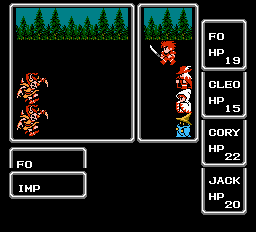
Final Fantasy's battle screen
Final Fantasy’s battle screen

I could certainly write an entire game log entry on the effects of having DQV’s enemies face and attack the player directly, and of the heightened identification this induces with the game’s protagonists. However, I’d actually like to zero in on a particular scene, where DQV exploits its first-person battle perspective to heighten the tragedy of an early plot twist.

DQV’s story spans the entire lifetime of the game’s silent Hero (capitalized here because the player does get to choose the protagonist’s first name), so at least a little exposition is necessary for me to explain the scene I have in mind. The game’s first few hours depict the Hero’s childhood as he embarks on incrementally more exciting adventures, from freeing a helpless villager trapped under a boulder, to saving a tortured wildcat kitten, to ridding a haunted castle of its ghosts.

This first act concludes with the biggest adventure yet: the Hero has traveled to the royal capital with his father, and within minutes are tasked with retrieving a kidnapped prince. The Hero and father track the kidnappers to their hideout, where the father rescues Harry and tasks his son with guiding the prince out of the cave and back to safety. They are inches away from freedom when a demon lord appears and swiftly defeats the Hero and prince.

The father arrives moments too late and engages in battle with the demon lord. At this point, the game transitions unexpectedly from exposition to gameplay, and the player is for the first time handed control of the Hero’s father. Battle proceeds as expected for a few turns, but is then interrupted by a sudden twist: the demon lord scoops up the unconscious Hero and holds a scythe to his neck, daring the father to continue attacking risk his son’s life.

The moments following the Hero's death in DQV
The moments following the Hero’s father’s death in DQV

Naturally, the selfless father refuses. The game transitions back into the battle screen, but now, the player is robbed of any autonomy. He/she must simply watch as the Hero’s father stands resolute and accepts the demon lord’s attacks. It takes over a minute for the father’s massive health bar to reach zero, at which point the battle concludes and the father dies (permanently and canonically, unlike typical in-battle deaths).

It would have been wounding enough to simply show the Hero’s father, up to this point invincible and infallible, suddenly slain in a cinematic interlude. But by transporting the tragic event into the battle screen, the player becomes acutely aware of a number of factors, all of which heighten the scene’s emotional resonance. First, we experience the true resolve of the father’s love for his son as he withstands a barrage of attacks from the villain. Second, our surprise at this narrative twist is compounded by a shift in gameplay, as the typically free battle menu is suddenly converted from a gameplay interface to a mere set piece. Finally, we are aligned with the father and placed in a scenario painfully similar to his own: desperate to act, but forced to endure.

Cited

Galloway, Alexander. “Gamic Action, Four Moments.” Gaming: Essays on Algorithmic Culture. University of Minnesota Press, 2006.

Retcon Artists

PC-gaming purists love to argue that the computer is the superior system for playing first-person games, which benefit from the laser like precision of a mouse and keyboard. Meanwhile, console fan-boys and -girls will themselves insist that an ergonomic controller offers a more comfortable experience, or that the vibrating “rumble” feature adds to a game’s immersion. Tactile differences … Continue reading Retcon Artists →

PC-gaming purists love to argue that the computer is the superior system for playing first-person games, which benefit from the laser like precision of a mouse and keyboard. Meanwhile, console fan-boys and -girls will themselves insist that an ergonomic controller offers a more comfortable experience, or that the vibrating “rumble” feature adds to a game’s immersion. Tactile differences aside, playing Portal on a PlayStation 3 console is an objectively different experience from playing the PC version, for reasons embedded not in the hardware but in the game’s actual coded content. Granted, to even notice these differences one needs comprehensive knowledge of both versions of the game; indeed, on my own playthrough of the PS3 port, I had no idea that my game disc featured different content from the original, updated PC version.

I almost miss my blissful ignorance. Now that I’m aware of how the versions diverge, I’m left pondering a dizzying number of questions regarding digital authorship, the impossibility of locating (spatially or otherwise) the “original” Portal, and the point at which two branched works become their own entities. I’ll tackle of a few of these questions here. Full disclosure, though: if I said I could provide the answers, too, I’d be about as dishonest as GlaDOS promising cake to Chell.

Some of the differences between the two versions are truly minute and, I would argue, trivial. For one, the graphics and performance of the PC version are scalable according to the power of your machine. This means that a high-end “rig” can make this nearly decade-old game look pretty darn good by today’s standards, and will keep the game running smooth as butter start to finish. Meanwhile, the PS3 version is locked at a resolution and framerate suitable for the console’s relatively weak horsepower. I personally don’t think that the difference in graphical fidelity is anything to write home about, since most players would need to see both versions side-by-side to even notice a difference. Likewise, the difference between 30 and 60 frames-per-second is significant, but not enough to significantly impact gameplay (largely because Portal rarely demands time-precise inputs from the player).

So, Portal PC and Portal PS3 look and play similar enough at first glance. But PS3 players need not play for long before encountering technical issues and glitches that the PC version, which has received a number of online “patches” or updates over the years, is now largely immune from. During my first playthrough of Portal on PS3 (the only version I’ve played), I noticed a faint crackling sound in one of the early test chambers. It began as a soft white noise that I barely paid any mind to, thinking it was an ambient effect or else was coming from something besides my TV’s speakers. But as I triggered other in-game sounds, like firing my Portal gun or inciting new dialogue from GlaDOS, the static grew louder and sharper, until it matched the volume of the un-glitched audio. I stubbornly gave Valve (the game studio behind Portal) the benefit of the doubt and figured there was some deeper, narrative meaning to the static – maybe Chell was slowly losing her mind, or GlaDOS overflowing the chambers with noise to make her lose her mind. Well, within a few minutes I was starting to go a bit crazy myself, so I turned to the Internet and Googled “Portal PS3 audio static.”

It turns out that Valve’s port of The Orange Box (a collection of games containing Portal, Half-Life 2, and more) from the PC to the PS3 is ridden with issues; audiovisual glitches, framerate slowdowns, and long loading times are present in every game on the disc. What’s more, while Valve has released a handful updates for the Xbox 360 Orange Box and many more for the individual release on PC, they’ve left Playstation in the dust. Apart from one small patch in 2008 (which had unknown impacts on the games) the PS3 version plays exactly as it did on release.

This lack of support from Valve also explains the largest and most fascinating point of divergence between Portal on PC and Portal on PS3. I was suspicious when I overheard a classmate declare during our second game lab that their own game ends with Chell being dragged away, back toward the Aperture building. My own lab group had just cleared the game’s last chapter ourselves, and my PS3 definitely left Chell’s body motionless until the screen fades to black. Still, the alternate ending made sense with consideration to the game’s sequel, which has Chell still trapped inside Aperture. So, I turned again to the oracular Web and discovered that, sure enough, Valve slightly altered Portal‘s ending on PC in the months leading up to Portal 2‘s announcement. Of course, the PS3 never received the update, and thus still boasts the original (and somewhat more optimistic) closing scene.

Valve’s decision to “retcon”, or retroactively alter, Portal‘s ending points to, among other things, the studio’s conception of the fluidity of their game’s narrative and their own authority to mold it. That Valve opted to change the ending not through a tweet or blog post but with a full-on patch is particularly illuminating. I would argue that delivering the new ending with the same mechanism used to administer gameplay adjustments and bug fixes renders narrative in the same light as those elements. In digital games, narrative and gameplay elements alike are mutable, moldable, and never immune from being revised or removed entirely by their creators. Furthermore, Valve’s decision to overwrite the game’s closing moments (rather than offer the new scene as an alternate or supplemental option) is a serious assertion of their claimed authority to determine what is and is not “canon” for Portal‘s game-world. I have no doubt that many, if not most players have only seen one version of the game’s ending and are oblivious to the other’s existence. If not for the PS3 port’s functionality as an effective time capsule for the game’s original release, preservation of the “old” ending would rely on early players having backed up or otherwise documented their version of the game.

For a medium that so frequently emphasizes player autonomy, the modern, always-online video game places a great deal of power in the hands of the author.